Dorrigo Evans—Darky Gardiner
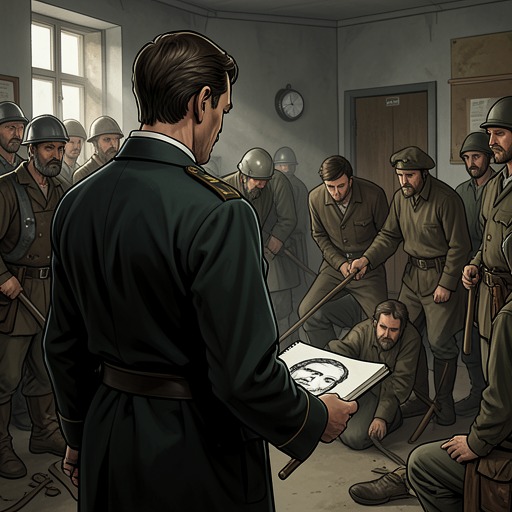
The Narrow Road to the Deep NorthDorrigo Evans’s bond with Darky Gardiner takes shape as a test of medical care, command, and responsibility under coercion. When Darky is taken from the hospital to be punished, Dorrigo tries to intervene, but cannot prevent the assault. The episode turns their relationship from a matter of a doctor’s concern for a patient into a lasting moral crisis: Dorrigo sees that care and authority do not guarantee protection, and that he too is implicated in the silence surrounding the violence.
A doctor’s responsibility
Dorrigo’s concern for Darky belongs to a broader commitment to the men in his care. He tends to the sick and injured, carries and nurses prisoners, and continues trying to save lives even as more men die. His sense of duty is not founded on the idea that suffering makes people virtuous. As a doctor, he regards suffering as suffering: it does not automatically produce goodness or meaning. That distinction matters when Darky is singled out. Dorrigo does not treat his illness as a moral failing or punishment as something that could make him stronger; he sees a sick man who needs rest and medicine.
The episode also follows Dorrigo’s insistence that the prisoners’ needs remain concrete amid the camp’s brutal conditions. On another occasion, he orders two exhausted men to help a gravely ill prisoner who cannot make it back from the end of the Dolly. Their reluctance is understandable within a struggle for survival, but Dorrigo still makes them act. His care involves practical decisions and sometimes command, not merely sympathy. The contrast makes his later failure especially painful: he knows what responsibility requires, yet his authority cannot secure Darky’s safety.
The hospital and the delayed intervention
The crisis begins when an orderly reports that the Goanna has taken Darky out of the hospital. The guards have dragged him away, ostensibly because men are missing on The Line, and a punishment assembly is underway. Dorrigo is then occupied with Jack Rainbow’s operation. When told that John Menadue believes only he can stop the punishment, he puts the appeal off, concentrating on the immediate surgery. The delay is brief in the telling but decisive in its consequence: by the time Dorrigo runs toward the gathering, the punishment is already proceeding.
Dorrigo arrives despite his own ulcerated ankle and calls out as he approaches. The Goanna ignores him, and a guard pushes him into the front row. Dorrigo steps out and appeals to Major Nakamura and Lieutenant Fukuhara, emphasizing that Darky is severely ill and needs rest and medicine rather than a beating. The prisoners observe that Major Nakamura acknowledges Dorrigo’s superior rank with a slight bow, while Dorrigo does not return it. The gesture marks the formal authority Dorrigo brings into the encounter, but it cannot make the officers stop what is happening behind him.
Care without power
Dorrigo continues to object as the punishment goes on, insisting that it is wrong and that Darky is very sick. Major Nakamura answers through Lieutenant Fukuhara that extra quinine is available to help sick men work, invoking the Emperor’s will and the railway’s needs. Dorrigo understands that Nakamura may help some prisoners in limited ways, but that practical aid does not interrupt the violence inflicted on Darky. The exchange exposes the difference between treating illness insofar as it sustains forced labour and protecting a person from punishment. Dorrigo’s medical judgment is heard, but it does not govern the camp.
The scene makes that powerlessness collective as well as personal. About three hundred prisoners watch, and none intervenes. Dorrigo recognizes himself as foremost among them: he came too late, did too little, and now feels that his presence has become a kind of assent. His failure is not simply that he lacks the force to command the guards. He has also participated in the same helpless witnessing as the men around him, even while knowing that Darky needs protection. The distinction between the doctor who acts and the prisoner community that watches becomes painfully unstable.
Moral aftermath and significance
As Dorrigo watches, the repeated violence seems to disclose a world in which horror cannot be escaped and violence persists across human history. The insight overwhelms him and then slips away. Its brief appearance matters: for an instant, he cannot make the camp’s brutality fit within reassuring ideas about duty, virtue, or progress. The scene does not offer him a clean moral victory. He has spoken for Darky and tried to use his rank, but the punishment continues; the intention to help cannot undo the delay or the helplessness of his appeal.
The relationship therefore reveals both the force and the limit of Dorrigo’s care. He loves the men he tends and keeps working for them, yet he knows that he is failing in that love as more of them die. Darky’s ordeal concentrates that contradiction in a single encounter: Dorrigo recognizes a patient’s need, acts on that recognition, and still cannot protect him. The episode makes responsibility more complicated than either simple blame or simple exoneration. Dorrigo is not the author of the punishment, but neither can he regard himself as untouched by what he and the other prisoners witness.